


THE HALLWAYS IN BETWEEN HOUSES
During certain seasons we feel stagnated and not even able to rest. Often, we think of a long hallway between open doors. A hallway between the before and after. I imagine it like moving between houses. The old place is familiar, even if it was unhealthy. I knew where everything was, including all the hiding spots. The new house appears unknown and unsettling, especially to those of us who learned early control, preparation, and self-protection brings safety.
I like the image of between houses because I want to take everything from the old house to the new one. I want to know what it will look like, how I can decorate it, what colors to paint the walls, and even the neighborhood. But when God moves us, He generally does not provide those details. In fact, He often gives us a direction to move towards without the final destination or even the dimensions of our new house. Which makes packing all that much harder. What to take, who is coming with us, how do we prepare? It can become an internal battlefield when we realize the “what's, who’s, and how's” are our familiar survival skills.
But God provides a wide variety of artillery for that battle. In fact, sometimes the hallway is a blessing because it gives us time to lay one useless defense mechanism down to pick up a coping skill. One such godly weapon is humility. Not the kind of false humility that says, “I am small and insignificant,” but the kind that says, “I do not have to defend myself right now. Even if I am uncertain about the next house, I know Whose I am and Who is moving me.” Fear and insecurity often rise from woundedness, from the need to protect what already feels fragile. Humility quiets that reflex and creates space for God to meet us as we are.
Praise also provides one of the greatest spiritual coverings. Not because we feel strong or even grateful, but because we are exhausted, spiritually and emotionally. A simple, “Thank You, Jesus” offered through fatigue invites holy power. Scripture tells us God inhabits the praises of His people. Praise reorients us without denying the pain and uncertainty. It pulls our focus away from what hurts and reminds us of the source of our strength.
Shame complicates hallway seasons. Those of us who have lived with shame and trauma often try to pack everything from the old house, just in case. We overthink. We distract ourselves. We numb out. We tell ourselves we need more time, more clarity, and more information before we can move forward. Really, we are attempting to avoid vulnerability.
The Holy Spirit provides us with His joy, regardless of circumstances, to combat shame and vulnerability. The joy of the Lord becomes our strength when our knees feel weak and unable to move. That strength is not found in knowing what is next or being happy about the move, rather in trusting Who walks with us.
God does not rush us through the hallway. Nor does He demand we know how to decorate the next house before we get there. He asks us to be present. To let go of what no longer belongs. To carry only what He requires. In this way, prayer opens our hearts and minds to His packing instructions.
If you are standing between what was and what will be, you are not failing. You are transitioning.
Talk to Him. Journal about it. Name what you are avoiding. Notice what you are ready to trade. Tell Him what you fear to leave behind and what you want to take. Even if you pack your “favorite self portrait” to hang on the new wall, God will give you the power and authority to take it down when it no longer fits in your new home.
Prayer
Father God, Thank You for meeting us in the in-between places. Forgive us for trying to control rather than trust. Where shame tells us to hide, help us choose humility instead. Where fear urges us to pack everything from the past, show us what belongs in the next season. Teach us to live in this moment, to praise You here, and to embrace that You are already waiting for us on the other side.
Amen.
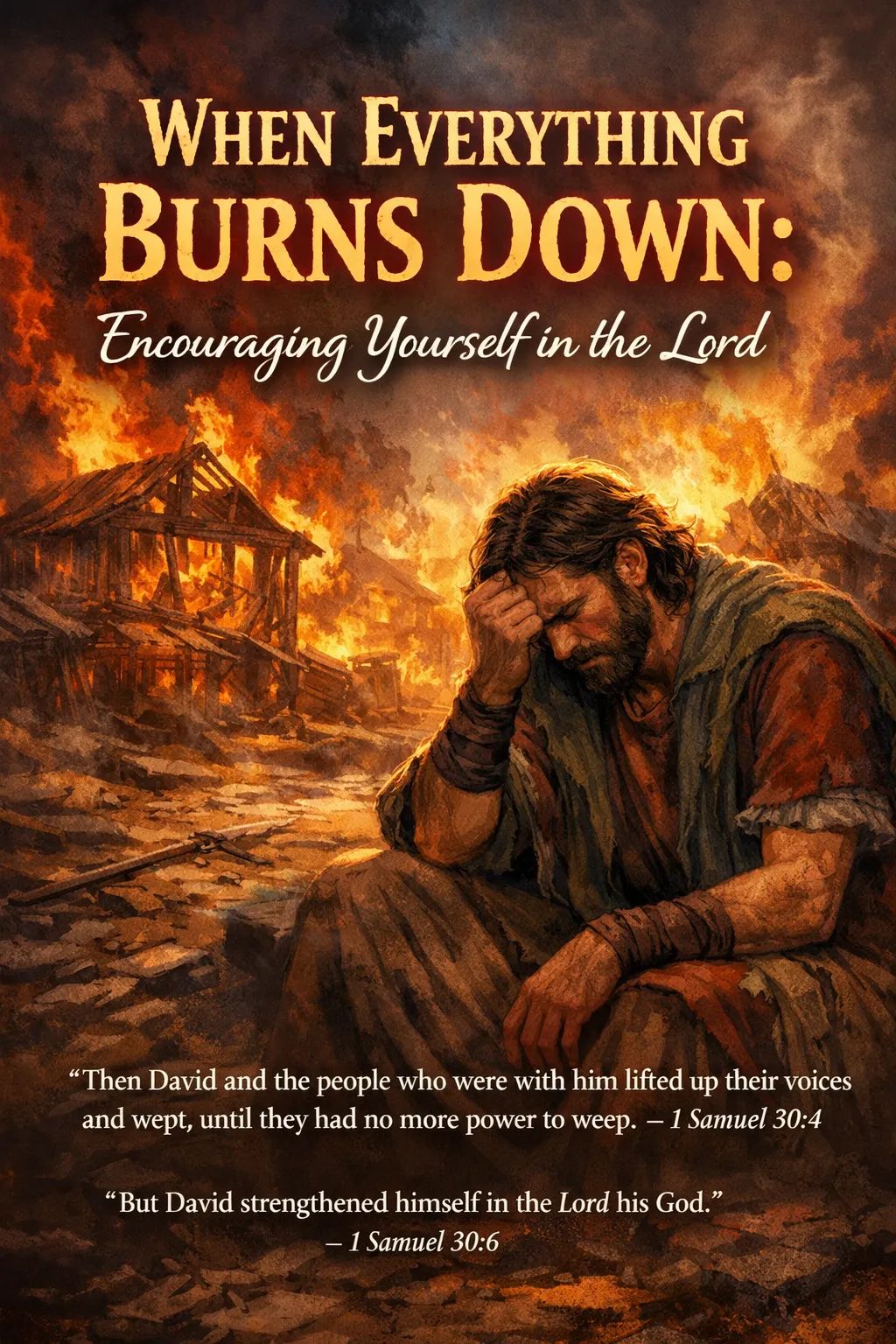
In life, loss may not come one piece at a time. Sometimes, it comes all at once.
We witness that moment in 1 Samuel 30.
David and his Mighty Men spent months fighting battles and winning victories. Territory after territory fell into their hands. Success followed them. Momentum carried them. They were warriors on a winning streak.
They returned home looking forward to seeing their wives and families, having a soft bed to sleep on, receiving revelries of celebration, and hearing the laughter of children after the screams of the dying. Instead of rest, they saw smoke.
The Amalekites burned their city to the ground while they were away. Their homes devastated. Their wives and children stollen. Everything they loved completely gone.
Scripture hides nothing, including the vulnerability of mighty warriors. Warriors like you and me.
“Then David and the people who were with him lifted up their voices and wept, until they had no more power to weep.” (1 Samuel 30:4, NKJV)
These were not weak men. These were the Mighty Men of David, battle-tested soldiers. Yet this loss broke them. They cried until they physically could not cry one more tear. Sometimes, trauma reaches that level. It overwhelms the emotional system. Strength alone cannot carry it.
Just when David felt he had nothing left to lose, his own men threatened to stone him. The same men who faithfully fought beside him now blamed him. Grief turned into bitterness. Pain looked for someone to punish. David found himself alone in the middle of devastation.
The Scripture describes his condition in a single phrase:
“David was greatly distressed...” (1 Samuel 30:6a, NKJV)
Everything around him collapsed, and the men he called friends and brothers threatened to kill him! Instead of running or panicking, David did something inspirational.
“...But David encouraged himself in the Lord his God.” (1 Samuel 30:6b, NKJV)
David needed to strengthen his own soul. We cannot escape these moments either. When we can take no more and feel there is nothing left to be taken, our options appear very bleak. To survive, we need to follow David’s example.
Not because community is not important, but because sometimes the crisis comes when no one else is strong enough to carry us. At some point, we must learn how to encourage ourselves in the Lord.
First, Remember What God Has Already Done
Rehearsing your history with God is one of the most powerful ways to strengthen your spirit. Rehearsing the grief only leads to further emotional, mental, physical, and spiritual destruction. Remember all the, “but God” moments.
David had a history. He faced a lion, a bear, and Goliath yet he survived. Every one of those moments proved something about the character of God. When David encouraged himself in the Lord, he likely remembered those moments. He reminded his own soul that God never failed him before.
Trauma narrows our vision until we see only the present loss. Encouragement widens our memory until we remember God’s faithfulness. Sometimes the most powerful spiritual discipline is simply remembering victories not failures, unexpected blessings not years of struggle, and those moments when death was a distinct possibility, BUT GOD intervened. Those memories rebuild courage.
Second, Remember You Are Not Alone
Encouraging yourself in the Lord also means remembering that God’s protection carried you farther than you realize. Scripture repeatedly describes God’s unseen mercy and grace: angels standing guard, His Holy Spirit’s guidance, and Jesus’ ransom for our lives. As we look back, we remember the accident that nearly happened, the unexpected opportunities, and the provisions either at the 11th hour or without us even asking.
God’s protection rarely announces itself loudly, but it surrounds us more often than we notice. Remembering that truth steadies the soul. It reminds us even when circumstances collapse, God remains steady and accessible.
Third, Remind Yourself Who God Is
David’s strength did not come from his circumstances. His strength came from the character of God. Scripture describes God with names that anchor the heart during crisis:
He is Jehovah Jireh, the One who provides.
He is Jehovah Shalom, the One who brings peace.
He is Jehovah Rapha, the One who heals.
He is Jehovah Nissi, the banner of victory.
Reclaiming our lives often begins by concentrating on Jehovah and His many unfailing characteristics. All of which reside within us when we abide in Christ and He in us.
David models an inspirational ability: the ability to remain grounded in the moment yet anchored by faith. He did not deny the devastation around him or the men threatening him. Instead, he found strength to move not only himself but his men forward. Because, he knew God was and always will be God.
The Turning Point
Many of us imagine some climatic moment when everything shifts. Angels singing, doorbells ringing after years of silent loneliness, or winning the lottery without buying a ticket. However, usually God operates more on the quieter side.
Like David, we ask God for direction.
“Shall I pursue this enemy? Shall I overtake them?” (1 Samuel 30:8a, NKJV)
God’s answer was immediate and decisive:
“...Pursue, for you shall surely overtake them and without fail recover all.” (1 Samuel 30:8b, NKJV)
We take a deep breath when we think of God restoring ALL we lost. What a monumental moment that will be. But what if… what if we are limiting Him to 100% when He wants to give 200%?
David’s Spoils
David knew God would restore his family members, possessions and resources. He simply had to obey God… even with the dread of returning to war with a nation known for brutality. And, as Jehovah said, David and his men received everything back.
But something else happened. As David defeated the enemy, he discovered that the Amalekites possessed wealth beyond their expectation. The Amalekites accumulated livestock, goods, and treasures from all around them in their camp.
David returned not only with what he had lost. He returned with more. Scripture calls it “David’s spoil.” In other words, the crisis did not end in mere survival. It ended in increase. God did not allow the story to finish with loss. He redeemed the devastation and produced extravagant abundance.
This pattern appears repeatedly throughout Scripture. Joseph lost years of his life yet rose to leadership over nations. Job lost everything, yet God restored double. Israel left Egypt not empty-handed, but carrying the wealth of their oppressors.
God has a way of turning valleys into places of unexpected provision. Not every hardship resolves quickly. Scripture never promises that. Rather it shows us God’s redemptive power. Loss does not always get the final word.
Your “Until” Moment
Before David encouraged himself in the Lord, the men wept until they had no more power to weep.
That word “until” matters.
We experience the grief process. We shed the pent-up tears. We recognize our faith holds us steady. The Bible never shames those moments of sorrow. Therefore, grief and despair never end our testimony.
At some point, every soul reaches an “until” moment. Until the tears stop. Until the mind grows quiet. Until the heart lifts its head again.
After the desperate "until" moment, we strengthen ourselves in the Lord, remember His faithfulness, and ask Him for our next move. Because the story that began with ashes rarely ends there. Sometimes God writes a final chapter that looks like recovery… and spoils besides. Spoils that come in many forms.
*This post was inspired in great part by Jensen Franklin’s sermon: How To Encourage Yourself | Pastor Jentezen Franklin https://www.youtube.com/watch?v=Z9fz802lmK8&t=2950s

I often sleep with a stuffed unicorn at night. Her name is Miss Innocence. Recently, God used her to expose something about myself.
He continually downloads new revelations and breaks strongholds in me, even at a greater level than ever before. With each truth comes deliverance from decades of accumulated lies about myself and about God.
A godly woman gave Miss Innocence to me; she knew I often use stuffed animals to support an injured shoulder in my sleep. But God divulged something deeper; in His eyes, I am His Miss Innocence.
When I think of unicorns, it is not about mythology, but rather the imaginations of young girls. When I was little, my dad let me choose the wallpaper for my room at his place. It was off-white with fluffy white clouds, rainbows, and playful unicorns.
To a traumatized little girl, that wallpaper was an invitation to escape, to ride off to places of abandon on the back of something fanciful and freeing. The rainbow became my private promise of restoration and protection after the shame and trauma of abuse, just as God created the rainbow as His promise of safety and protection.
God adores me not because I proved my worth (believe me, I repeatedly tried), but because He sees that wee girl who found refuge in unicorns and rainbows. How appropriate the very place I associate with some of my deepest trauma was also where I found solace by riding away on my imagination. He reminded me that the traumatized, angry, confused little girl inside me chose joy, playfulness, and freedom instead of bitterness. That choice mattered.
This morning, every time I thought the word freedom, my arms automatically opened wide, exposing my heart to God. Without realizing it, my body responded by embracing a newfound abandon to simply be His little girl.
I pray you have such epiphanies too. Not because you fight for justice or you survived hell and back, but because you recognize who you are and where your strength comes from. Nehemiah 8:10 reminds us that the joy of the Lord is our strength. When we let God handle the injustices, He cuts what binds us to trauma, drama, and shame.
He does not see me as unclean nor the wheelchair I now use. He sees His little spitfire gymnast running on a mountainside, building a treehouse with her grandpa, dancing with abandon in competition, and daydreaming.
Knowing this gives me permission to see beyond the labels of disabled, tainted, traumatized, and to remember my unique identity. I am still a dancer at heart. I often picture myself frolicking spontaneously with beautiful movements to songs only He and I hear. Today, I prayed with an embodied freedom of a unicorn named Miss Innocence.
Now, I invite you to pause and reflect. Where did you find joy when life tried to teach you darkness? What did your inner child reach for — imagination, play, wonder — when pain tried to name you? Let Him show you how He sees you as innocent, beloved, and free. Let Him carry you across the clouds and through the rainbows.
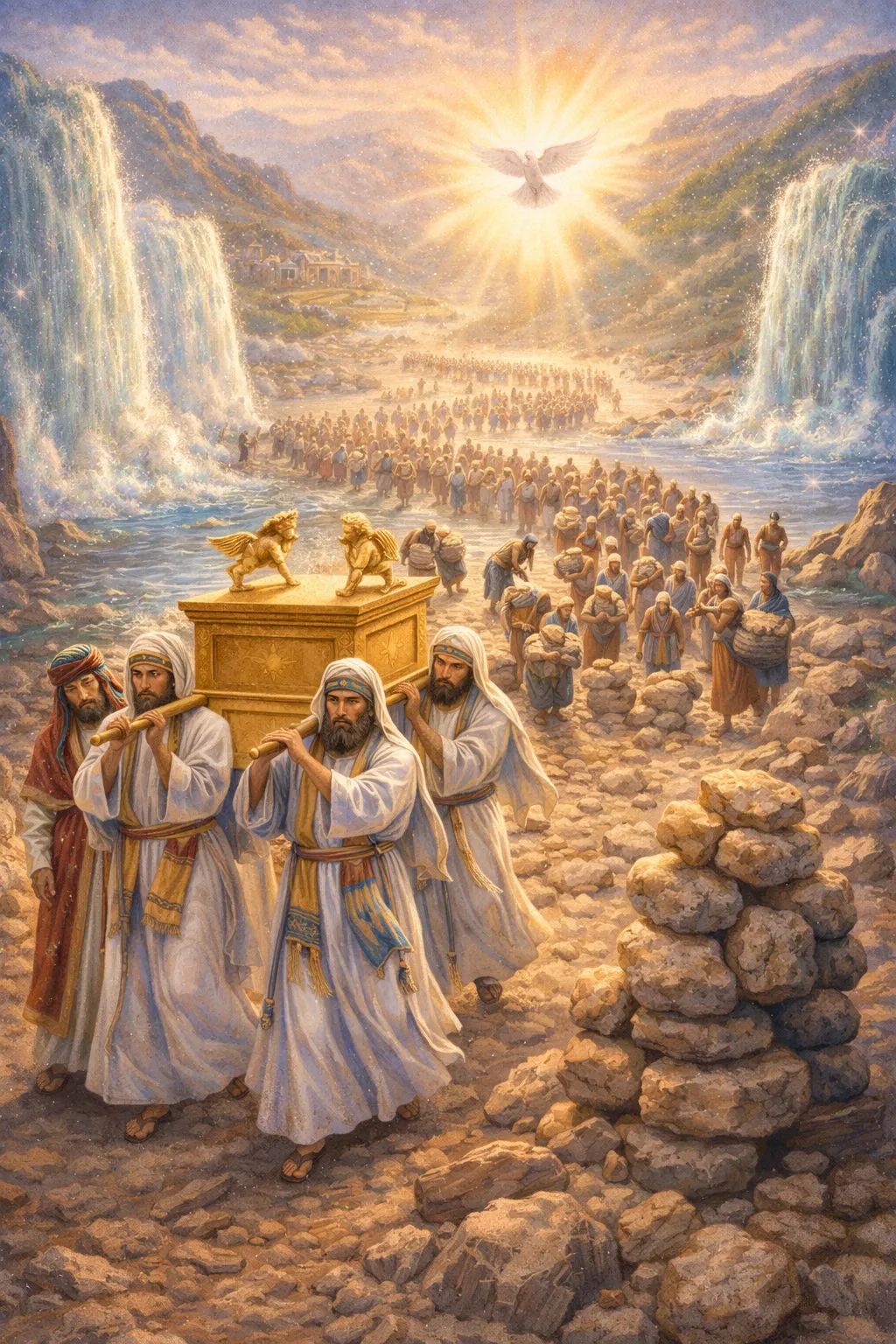
This Morning’s Contemplation: Joshua 3–4
I have read and written about Joshua 3 and 4 before, often sensing that I, too, have been standing at the edge of the Jordan for some time. Yet this morning, I noticed more.
At last, the wandering Israelites prepare to enter the Promised Land, only to face a raging, flood-stage Jordan River. Joshua has assumed leadership after Moses, and he listens carefully to the Lord. At God’s direction, the Levitical priests step into the river carrying the Ark of the Covenant; remaining there as nearly two million people pass safely by. They must have been utterly exhausted by the time the crossing was complete. I have always imagined towering walls of water pressing in on the people, intimidating those who had only heard stories of the Red Sea. But, two details stand out to me today.
First, God stopped the waters far upstream, out of sight. The people could not see the violent current piling up against an invisible wall. God removed the terror of being swept away if something went wrong. When God calls us to cross our Jordans, He brings a peace that surpasses understanding—even when we know the waters could destroy us in a moment. For leaders, this peace is essential. How can we lead others into unfamiliar and overwhelming territory if we ourselves are consumed by fear? Joshua modeled trust by following behind the priests, allowing his actions to communicate God’s peace more powerfully than words. He moved neither too early nor too late. Joshua, demonstrating sensitivity to the Spirit’s timing, he obeyed God’s instructions without adding his own emotions—unlike Moses, who struck the rock rather than speaking to it. Four priests bore the weight of the Ark without dropping or touching it, reminding us that while leadership is heavy, Christ’s yoke remains light when we trust Him.
Second, God instructed Joshua to build a monument—not merely a tribute, but a marker of memory and transformation. One man from each tribe returned to the dry riverbed, to the very place where God’s presence had held back the waters, and carried out a stone. These men went back into what had represented fear, danger, and death to retrieve tangible reminders of God’s power. The stones came from ground where two million people had walked in peace, worship, and awe, moving through their own “valley of the shadow of death.”
These monuments were meant to remind God’s people of His faithfulness—not only in victory, but in moments of defeat. We, too, are called to lead people through dark places: addiction, abuse, disbelief, spiritual confusion, and deep pain. We are chosen to lead specific people at specific times, not by our own strength, but by listening and acting as God directs. Sometimes He may call us to walk back into hard places to bring out living monuments—people who entered one way and emerged transformed.
My prayer is that we draw from Joshua 3 and 4 in our ministries: walking in God’s peace and timing, trusting the authority He has given us, allowing the Holy Spirit to work without interference from fear or emotion, and remembering His deliverance when we are weary. May we look to the monuments of God's grace rather than imagining the waters about to collapse.
About Jodi
Jodi Gardner excels in reaching those impacted by shame and trauma as evidenced by her effective outreach ministries, counseling career, public speaking, vlogging, and now as an author of Ransomed to be a Sanctuary Series.
